
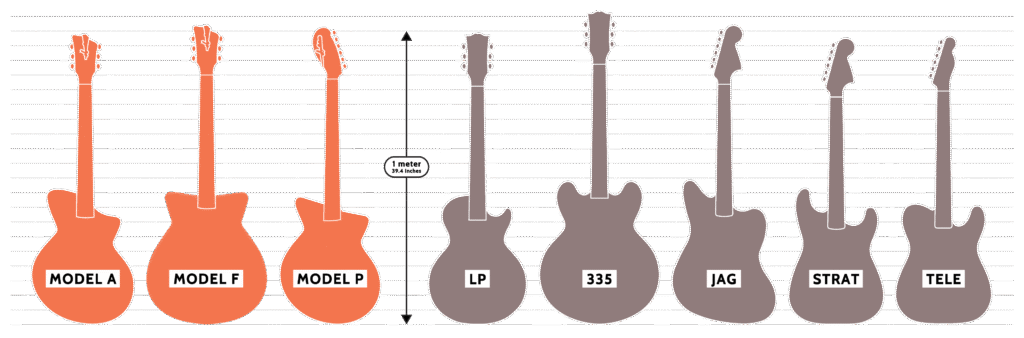
In the pictures below you will be able to visually get a sense of the dimensions by comparing it to some well known guitars.
Useful info
Important info to read before ordering.


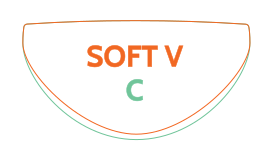
Neck shapes
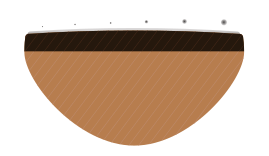
When you start selecting the specs for your Daro in the order form, you’ll notice that neck shape and neck thickness can be chosen independently. For neck shapes, we offer a C shape and a soft V shape, which is a personal favourite.
The C shape is a familiar neck profile, visualised as a ‘C’ in the neck cross-section. The soft V shape has a little less material just below the shoulders and, although this does not apply to everyone, players who like to use their thumb over the neck often feel more comfortable with this profile.
Both profiles remain consistent along the neck until the heel transition begins.
Each of the two neck shapes is available in three thickness options: thin, medium, and chunky.
Also possible to choose the different nut widths. 42mm narrow, 43mm medium and 44mm wide
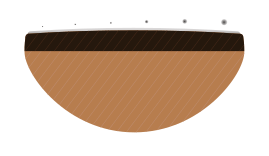
C shape
Thin
Thickness:
1st fret – 19.5mm
12th fret – 21mm
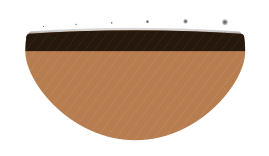
C shape
Medium
Thickness:
1st fret – 21mm
12th fret – 22.5mm
C shape
Chunky
Thickness:
1st fret – 22mm
12th fret – 24mm
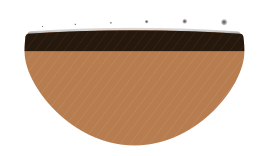
Soft V shape
Thin
Thickness:
1st fret – 20mm
12th fret – 21.5mm
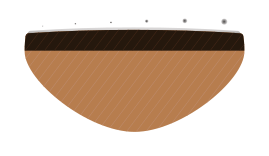
Soft V shape
Medium
Thickness:
1st fret – 21.5mm
12th fret – 23mm
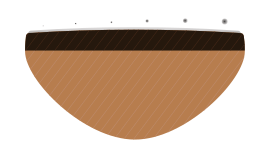
Soft V shape
Chunky
Thickness:
1st fret – 22mm
12th fret – 24mm
Colours and types of finishes
In this section you’ll read about how to order and select your colours and finished with example pictures. You’ll also learn what is the oil n wax finish we use and matching headstock stands for.
Colour types
We don’t offer a fixed colour catalogue. Instead, you simply select the type of colour, and we’ll define the exact colour tone together afterwards. Here are some examples of the colour types we offer: solid colour, translucent colour, sunburst style, no colour (natural wood), metallic, and sparkle.
Solid Colour

Translucent Colour

Sunburst style

Natural Wood

Metallic

Sparkle

Type of finish, or clear coats.
We offer four options:
Nitro Gloss – A flat and glossy finish. It looks pristine and shiny when new, but over time it will shrink slightly and lose some of its flatness and sheen, and mark more easily than tougher finishes. This fragility is something many players enjoy. Nitro is the finish used on many classic guitars, and the patina and feel it develops over time can be very attractive.
Light Nitro – A very thin coat of nitro applied without much pore filling, allowing t he wood texture to be felt through the finish. This type of finish will start to look aged faster than standard nitro gloss.
Light Nitro Relic – A light nitro coat with some ageing applied intentionally: finish checking, little scratches and dings here and there, lightly aged hardware, and a less glossy appearance.
Polyurethane Gloss – The toughest finish we offer. Ideal for players who want to keep a clean, pristine look for as long as possible.
Nitro Gloss

Light Nitro

Light Nitro Relic

Polyurethane Gloss

Matching headstock?
A matching headstock means the face of the headstock is painted in the same colour as the body. This is an optional feature. Otherwise, the headstock will have a natural wood finish: the same wood as the fretboard on Models A and F, and maple on Model P.
Oil and Wax neck finish
For those who like the soft and velvety wood texture on their guitar necks. Oil finished and polished with an hard wax. This finish will require some maintenance over time.
Natural back
Top colored and a natural back can look very nice.
Matching headstock

OilWax neck finish

Natural Back

Bindings and pickguards
Pickguards
All of the 3 Daro models are projected with a pickguard. The model A has two options. Model F and P have only one design for each.
Model A
Wing style pickguard

Model A
S style pickguard

Model P

Model F

Bindings
You can choose how much binding you want on your guitar – Binding only on the top; Double binding (top and back of the body); headstock or headstock and neck. Multi-layered bindings, wooden purflings and other details are possible and you’ll see then in pictures of previews builds. Just let me know when ordering if you wish something like that. No binding option offered for the model P.


For materials/colors here are examples of what we typically use:
Celluloid Tortoise

Celluloid Ivoroid

Black, 1-ply

Cream, 1-ply

White, 1-ply

Parchment, 1-ply

Hardware
All hardware components are selected with equal consideration for performance and aesthetics. We prioritize structural integrity, precise machining, and long-term reliability. Each part must be mechanically solid and stable, allowing the instrument to resonate freely without unwanted energy loss.
At the same time, hardware is a visual and tactile element of the instrument. It must feel good in the hand and contribute to the overall design language of the guitar.
Every configuration is carefully matched to the construction, geometry, and intended function of each model to ensure optimal mechanical performance, tonal response, and visual coherence.
Tuners
Model A and Model F
Equipped with Schertler or Kluson open-back tuning machines. These open-gear designs reduce headstock mass while maintaining smooth gear engagement and precise tuning control. They also allow easier inspection, lubrication, and long-term maintenance.
Gotoh Kluson-style locking tuners are available as an option.
Model P
Fitted with Gotoh Kluson-style tuners, available in locking or non-locking configurations. A Standard of quality. Consistent rotational resistance, precise tuning control. Looks of the classics.
Schertler
open backs

Kluson
open backs

Gotoh
kluson style

Gotoh
Locking

Bridges and Vibrato Units
Model A and Model P with DG Tremolo
When configured with the DG Tremolo system, we use the KMS JAM bridge. This bridge is chosen for its structural rigidity, string slots that allow the string to glide smoothly on top of the saddle and prevent the string to pop out of it, making it have a reliable return-to-pitch performance and stable general stable use with a vibrato system.
Model A with Bigsby B3 or B11
Features an ABM roller bridge combined with a Towner down tension bar.
The roller bridge reduces friction at the saddle steep contact point, allowing smoother string movement during vibrato use. The Towner tension bar enables precise break angle adjustment over the saddles without excessive downward pressure, preventing the string from popping out of the saddle, maximize tone and minimizing tuning instability commonly associated with traditional Bigsby setups.
Model F with Bigsby B3 or B11
When using a Bigsby B3 or B11 on the Model F, we do not pair it with an ABM roller bridge. The fully hollow body construction does not allow sufficient break angle to ensure the strings remain securely seated in the saddles during performance.
The fully hollow structure also does not permit the installation of a Towner down tension bar. The string break angle is established during the neck set process and, by design, cannot be made steep enough to optimize the performance of an ABM roller bridge.
For this reason, we take a more traditional approach on the Model F and use our TOM-style bridge configuration, allowing the strings to seat and glide securely over the saddle slots that we make sure are deep enough. In this context, a solid, fixed bridge without additional top-mounted hardware provides maximum tonal response from a fully hollow instrument.
We prefer this more rigid bridge design here, minimizing mechanical variables, preserving resonance, and ensuring string stability.
Model A and Model F with Fixed Tailpiece
Use a Göldo 3-Point Vario TOM-style bridge. The three-point design allows a solid saddle positioning, wasting very little energy with parts unnecessary vibrations. Therefore keeping a solid string-to-body energy transfer.
Model A and Model P
with DG Tremolo

Model A with
Bigsby B3 or B11

Model F with
Bigsby B3 or B11

Model A and Model F
with Fixed Tailpiece

Strap Pins
All models are fitted with self-locking strap pins as standard, ensuring secure strap retention without additional hardware modifications.

Custom Metal Parts
We manufacture some components in-house to make sure things sit were and how we want it and also to keep design coherence across the instrument.
This includes:
– Tailpieces
– Pickup rings
– Jack plates
– Logo plates


Model A construction options

Our model A is a versatile platform and it can be ordered in four main types: Semi-hollow with a Carved top, Solid body with a carved top, Solid Body with the top cut flat, Semi-hollow with flat top. With of without sound-hole is also an option.
This semi-hollow can get incredibly light. As light as 2.7 kg sometimes, depending on the hardware. I’ve always had a fascination with how a light guitar responds to your playing. Light semi-hollows in particular.

The remaining models, have only one body construction type. Model P is a solid body and the model F is a fully hollow, threstle braced, arched top.
